The farm has a water storage channel, which is used to water the leaves of the plants. When the humidity is below 65%, the drop irrigation system will be activated. The lighting and watering/irrigation systems are controlled via website. The roof works with automatic opening and closing depending on the light, temperature and rain sensors.
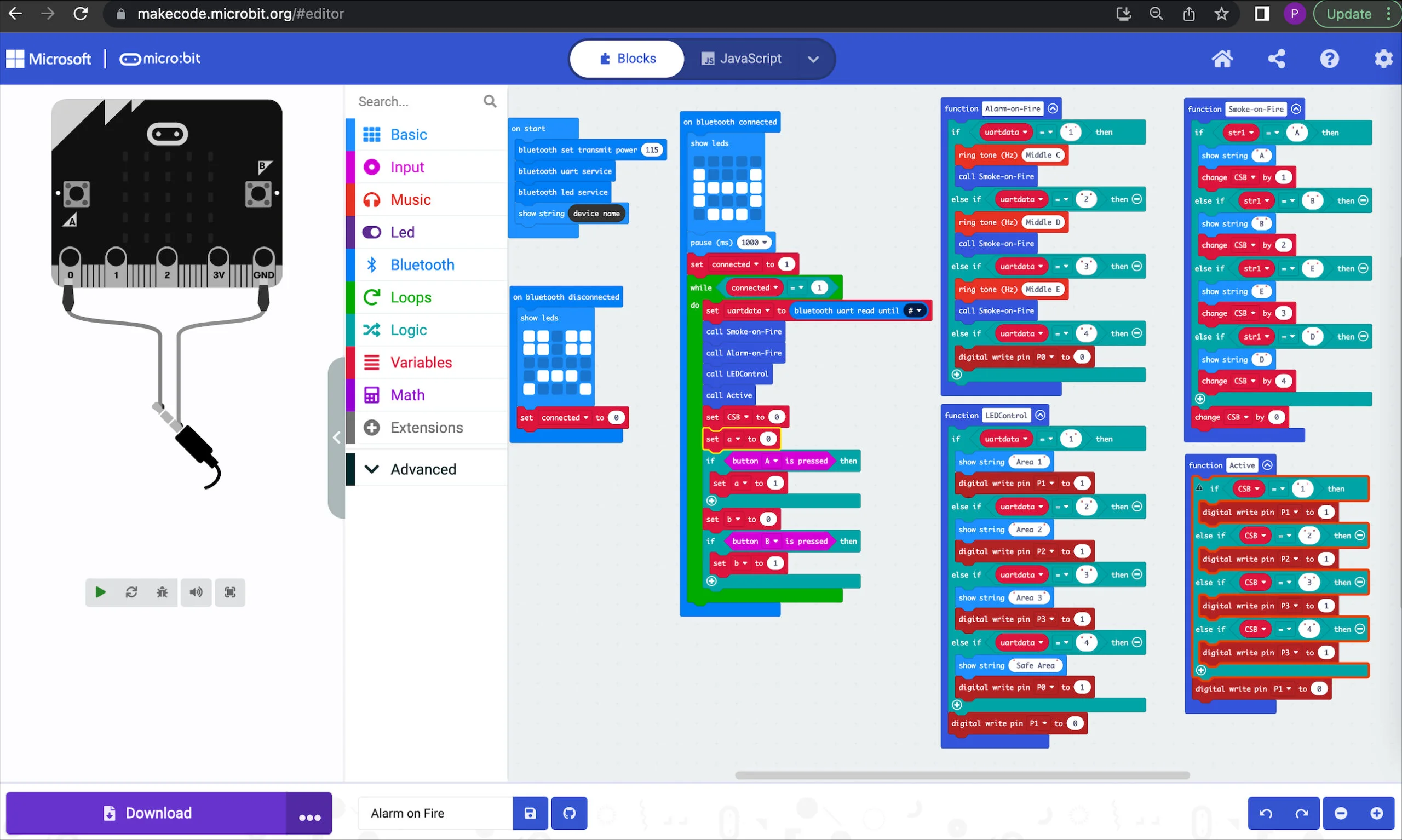
Bar fires often lead to a high death toll, because of suffocation, as there is no emergency exit. Our group decided to develop a project called Automatic Emergency System, based on how it works on airplanes; oxygen masks release whenever there is a drop in cabin pressure.
In case of emergency/fire, the system will automatically release custom-designed safety masks (with reflective strips) onto the floor which the people in the room can grab and put them on first, before they find their way out.
In each room, the smoke detectors are connected to the central system. In case of smoke detection, it will set the alarms on, and automatically release all the fire escape ladders, so people find their way out via thee escape ladders and don’t have to jump out of the building, which in many cases lead to deaths or severe casualties.
We are very pleased to announce that TDF signed a long-term partnership with Bread for the World, a globally active development and relief agency in Germany that empowers the poor and marginalised to improve their living conditions in more than 85 countries all across the globe.
Through the joint project, we intend to address the following main challenges of the public education system in rural and remote areas:
Lack of sufficient, adequate and functioning computer equipment to provide Digital Literacy education.
Computer courses largely focusing on theoretical skills. Students learn programming, but do not produce any simple product that can be practically applied. Accordingly, students are not motivated to participate in IT lessons.
Lack of qualified IT teachers, lack of updated curriculums and practical training programs.
Schools do not offer opportunities for students to develop innovative projects and grow their talents.
There is a tendency to divide the tasks within project teams accordingly. There is still a certain gender bias that technical work, including programming, is not suitable for girls.
BftW’s support will enable TDF to expand the project and to ensure that a high-quality digital education is mainstreamed into Vietnamese schools and create access to basic computer and coding skills for 1.2 – 1.5 million children between 2023 – 2025.
Furthermore, the project will continue to support existing partner schools with the aim to ensure sustainability of ongoing Digital Literacy classes and Coding clubs. In addition, the project will expand to new schools.
Munich, 26th January, 2023 – Moonfare kicked off its long-term partnership with Dariu Foundation and connects the charity’s mission with its exclusive investor community.
Moonfare, the leading global digital private equity platform, has announced it will support The Dariu Foundation with a series of events designed to give the NGO access to Moonfare’s global community and increase the visibility of its mission of fostering digital education for children. To kick off the partnership, Moonfare and Dariu were hosting an exclusive dinner in Munich on 26th January.
Moonfare founder and CEO Steffen Pauls, said: “The Dariu Foundation is doing excellent work in spreading access to coding skills to young, disadvantaged people in deprived communities around the world. Supporting its mission feels like a natural fit for a world-leading technology company like Moonfare especially given our determination to do our part in making the world a better place.” He added: “A young person trained by Dariu today may become a staff member at Moonfare or another tech company tomorrow.”
As part of “The Impossible Project,” TDF has committed to educating some 5,000 talented children in 250 code clubs within the next few years.
Such ambitious targets require the support of an engaged and like-minded community, which Moonfare can help to provide, as there are strong synergies between Dariu’s Digital Education project and Moonfare’s fully digital business concept
We are very pleased to announce, that we have won over Chai Schnyder as our 5th member of the Board of Trustees. The Board of the Dariu Foundation is now complete again.
Chai has been working for many years with her own family foundation to provide education and other help for disadvantaged children, with keen interest in Southeast Asia. Between 2011 and 2014, she was the chairwoman of the board of Ulysse Nardin SA, a Swiss luxury watchmaking company. She is the Founder and Chairperson of Fondation Rolf Schnyder.
Born and raised in Malaysia, Chai is a mother of 3, with an Engineering background. Her activities take her all over the world, while she calls Kuala Lumpur and Switzerland her home.
Alberto Venzago is a world-renowned photographer, photojournalist and filmmaker. Venzago’s photo reportages range on topics from organized crime in Japan to the revolution in Iran and have received international recognition. They have been published in magazines such as Life, The Sunday Times, Stern and Geo.
As a gift for our 20th anniversary, Alberto traveled to Vietnam to capture our activities on the ground, bringing back this wonderful movie.
Since 2002, the Dariu Foundation has been helping socially disadvantaged children in mostly rural areas in Vietnam and Myanmar to improve their opportunities through school and digital education. Today, the foundations special anniversary is being celebrated – in “The Studio” at the Ringier Pressehaus with a delicious flying dinner from the Zurich based Vietnamese Restaurant Co Chin Chin.
Since its beginnings, Ringier has supported the foundation both financially and with professional expertise from within the company – for the past year also in the way of corporate volunteering. Ringier employees donate their knowledge and time to support the foundation in various projects and tasks for which the foundation lacks the personnel.
Marc Walder, CEO of Ringier, says: “Around 65 percent of children will be working as adults in jobs that do not exist today. When it comes to training children in coding schools, the children from rural Vietnam are probably better equipped than many children in Europe – Dariu has played a significant role in this. My great respect and equally great thanks go to Thomas Trüb for his tireless efforts.“
Alberto Venzago, the renowned photographer and filmmaker has given us a very special gift: In May, he traveled to Vietnam with his crew and brought back this wonderful film:
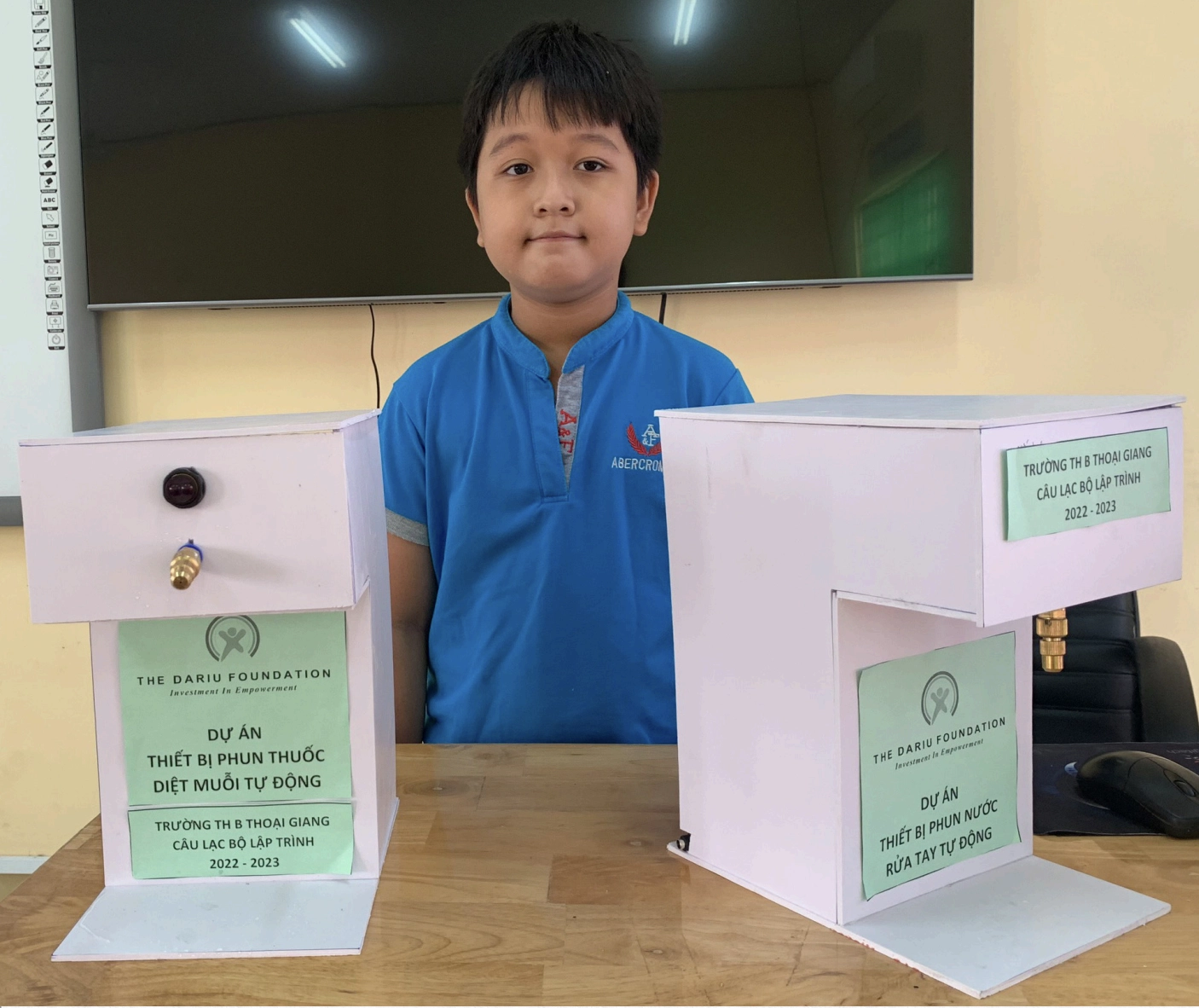
During the rainy season, mosquitos usually increase in numbers and schools are overwhelmed with mosquitoes. Therefore, a team developed an automatic sprayer, which emits chemicals to kill mosquitos.
The sprayers will be placed in classrooms, toilets and anywhere needed to spray the relevant chemicals, steered by a timer. Once the tank of chemical is empty, an alarm will sound, so that it can be re-filled.
In the future, an app shall connect the sprayer also to smartphones.
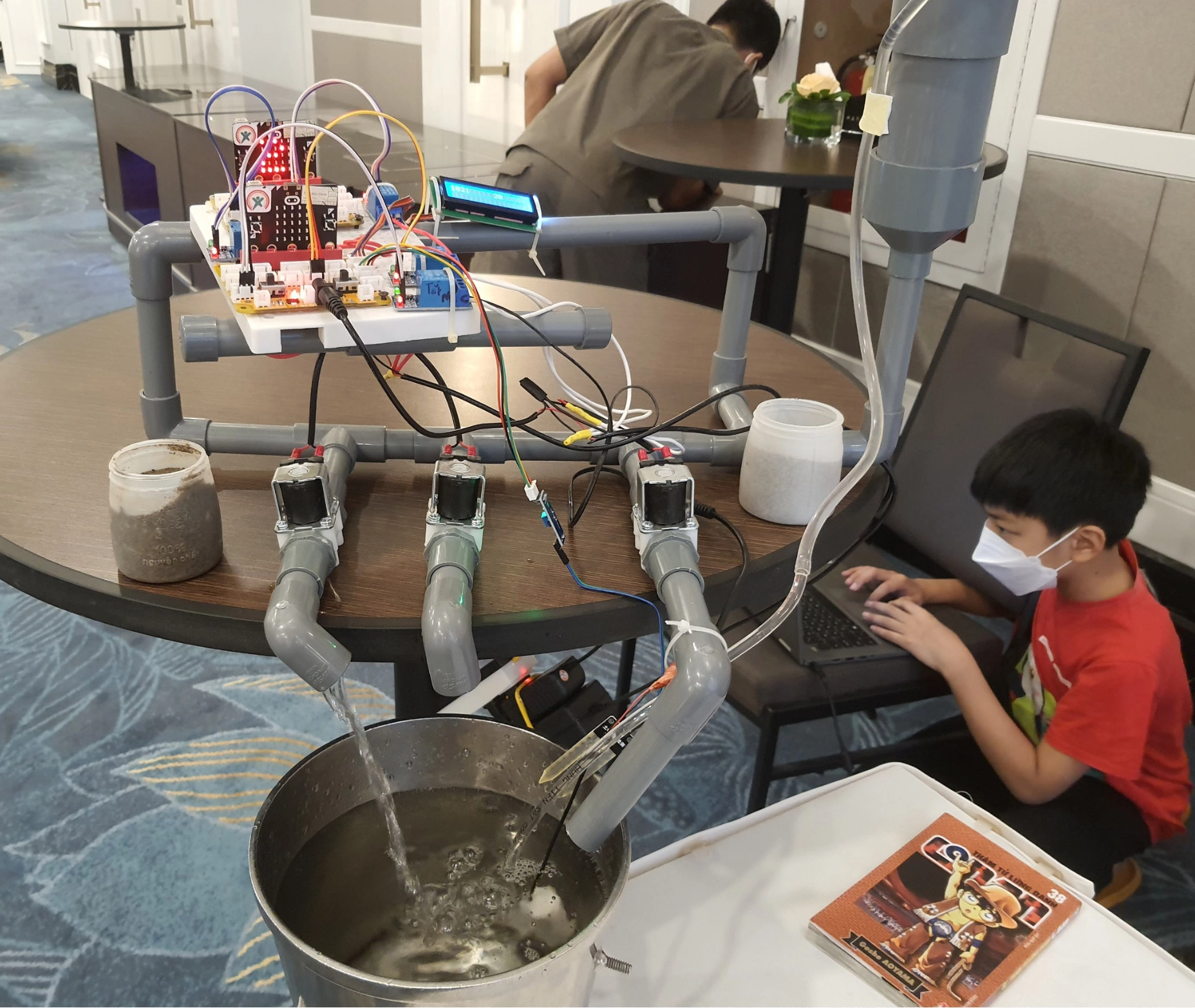
Watering flowers and plants is a time-consuming – and repetitive task. So the idea was born to help the gardener by taking the daily manual work off his hands, developing an automated plant watering device.
The central processor consists of a Micro:bit and an additional card connected to sensors for humidity, temperature, light and rain. The second processor – also a Micro:bit – is connected to the pump that controls the whole system.
The first processor measures the humidity in the soil, the temperature, the light and the rain and transmits the signal to the Lora card to automatically turn the pump on and off. When the pump is running, it sends the signal to the other processor to control the watering of the plants in the specified order and duration.
We did it! We have successfully prevailed against the other 4 finalists and won the Bett Asia 21st Century Learning Award for our Digital Literacy Initiative. This is a big success for us and our Code Club kids, as the award goes to the organisation that is using #EdTech effectively to develop the necessary skills to help students become independent and confident global citizens.
The award is a recognition for all 1,000,345+ Code Club kids who have received their DLI certificate and for those 230,000+ students currently attending the DLI training program (50% being girls).
Bett Asia is the region’s leading education technology conference and expo, gathering senior education leaders, educators and innovators to share intelligence on how to improve learning in the 21st century.